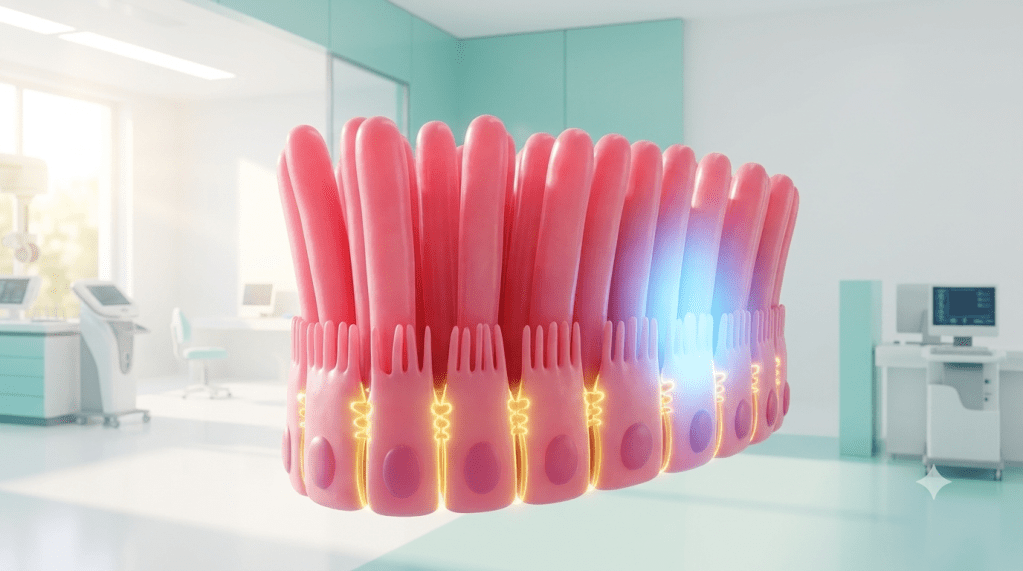
If you imagine your gut lining as a fortress wall, its job is to keep the “good” stuff (nutrients) in and the “bad” stuff (harmful bacteria) out. For people with ulcerative colitis (UC), this wall often breaks down, leading to what doctors call a “leaky gut”. Now, a new study published on July 10th has identified a specific biological “switch” that might be responsible for this damage – and how we might be able to fix it.
What the Research Discovered
The study focused on a molecule called Protein Kinase Cη (let’s call it PKCη for short) and its partner, a protein called MARCKS. These two work together like a construction team to keep the gut wall strong.
The researchers found that:
- Too Much of a Bad Thing: In the colon tissue of people with ulcerative colitis, the levels of PKCη were much higher than normal.
- The Chain Reaction: When PKCη is too active, it sends the wrong signals to the MARCKS protein. This causes the “mortar” between the cells of your gut wall (called tight junctions) to crumble, making the gut leaky.
- Turning it Off: In the laboratory, when scientists “knocked down” or blocked this overactive molecule in mice, the results were incredible: the gut wall started to heal, inflammation went down, and the mice began to recover.
How Big Was the Study?
This was a detailed mechanistic study that combined several layers of research. It wasn’t a large-scale drug trial yet, but it used:
- Human Data: Massive databases of genetic information from UC patients.
- Human Tissue: Samples of colon tissue taken directly from patients with ulcerative colitis to confirm the molecule was present.
- Animal Models: Mice with colitis symptoms to see if blocking the molecule actually worked.
- Cell Lab: Human gut cells grown in a lab (Caco-2 cells) to map the exact chemical conversation between the proteins.
The research was the result of a multi-year project conducted by experts across several specialist hospitals in China.
Why This Matters to You as a Patient
If you are living with UC, this discovery is important because it changes the way we think about treating the disease.
- A New Target for Medicines: Most current UC drugs focus on dampening down the whole immune system. This research suggests we could develop a more targeted medicine that specifically blocks the PKCη–MARCKS axis. This would focus on “repairing the wall” rather than just “stopping the army”.
- Less Invasive Monitoring: By understanding these molecular signals, doctors might eventually be able to use them as biomarkers. In the future, a test for these protein levels could tell your doctor if your gut wall is truly healing, potentially reducing the need for frequent colonoscopies.
- Explaining the Flare: This research provides a scientific answer to why flares can be so hard to stop once they start. Once the “wall” is broken, inflammation keeps getting triggered by things leaking through. Fixing the wall is the first step to long-term remission.
While this is still in the laboratory stage, it provides the “construction plans” for a brand-new generation of UC treatments.


Leave a Reply