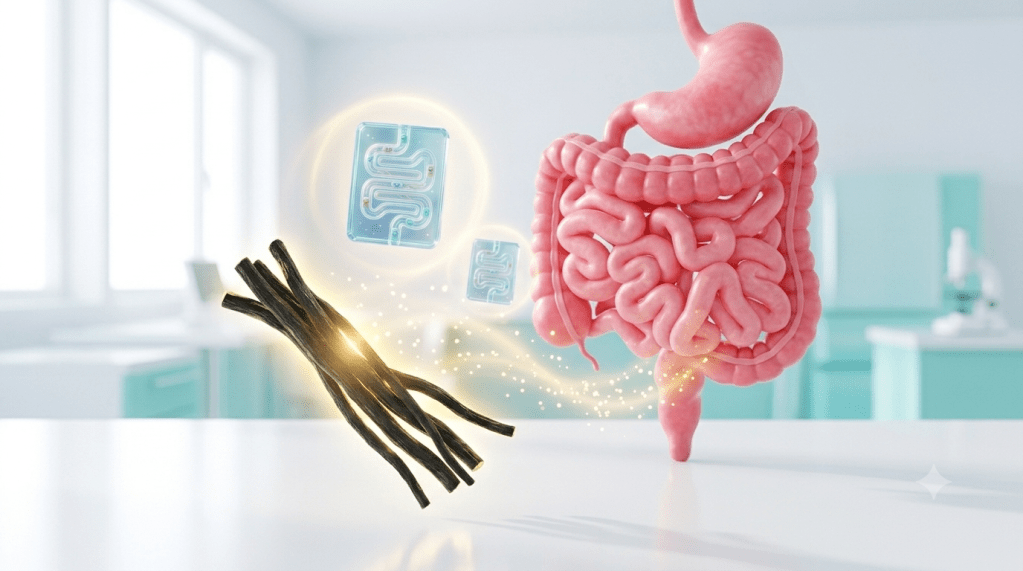
For many people living with inflammatory bowel disease (IBD), finding a treatment that works and lasts is a constant challenge. Current medicines, such as anti-inflammatory drugs and biologics, help many, but they do not work for everyone. Now, a team of scientists has found a promising new lead in an unexpected place: the root of the black liquorice plant.
What the Research Found
Researchers at the University of Tokyo in Japan have identified a natural compound in black liquorice called glycyrrhizin that acts as a powerful protector for the gut. This compound was found to significantly reduce the damage and cell death that typically happens during an IBD flare-up.
The discovery was made using a futuristic laboratory method. Instead of testing drugs on traditional cell cultures, the team created a stem cell-based model of the human intestine. They triggered an “IBD-like” state in these lab-grown tissues and then tested roughly 3,500 different compounds to see which ones could save the cells.
Glycyrrhizin emerged as one of the top performers. Not only did it protect the “mini-guts” in the lab, but further tests in mice with IBD showed that it lowered overall inflammation and prevented the intestinal wall from breaking down.
How it works
- Organoids (Mini-Guts): These are tiny, three-dimensional versions of human organs grown in a lab from stem cells. They are much more accurate than old-fashioned flat cell samples because they behave like real human tissue.
- High-Throughput Screening (HTS): This is a “new technology” where robots and computers are used to test thousands of potential medicines all at once. It is like trying 3,500 different keys in a lock simultaneously to find the one that fits.
- Stem Cells: These are special “master cells” that can turn into any type of cell in the body. Researchers used them to build a realistic model of your intestinal wall.
Study Scale and Details
This was a large-scale laboratory and animal study (pre-clinical). The researchers screened 3,500 compounds using their stem cell model. While the results in both lab-grown human tissue and mice are very exciting, it is important to note that this was not yet a human clinical trial. The research represents several years of development to create a reliable model of the human gut.
Why This Matters to You as a Patient
If you are living with Crohn’s or Colitis, this discovery offers three reasons to be hopeful:
- New Treatment Options: Glycyrrhizin offers a new way to fight IBD by focusing on preventing cell death in your gut lining, rather than just broadly suppressing your whole immune system.
- Natural Origins, Modern Science: While this compound comes from a plant used in ancient medicine, it is being refined using 21st-century technology to ensure it is powerful enough to help you.
- Faster Drug Discovery: The “mini-gut” model used in this study means scientists can test future treatments much faster and more safely, bringing new hope to you without years of trial and error.
Important Safety Note: Although this sounds like a “sweet” discovery, you should not start eating large amounts of black liquorice to treat your IBD.
Explore the Research
- Original News Report: Black liquorice compound shows promise against IBD.
- Original Journal Reference: Organoid phenotypic screening identifies glycyrrhizin protection.


Leave a Reply