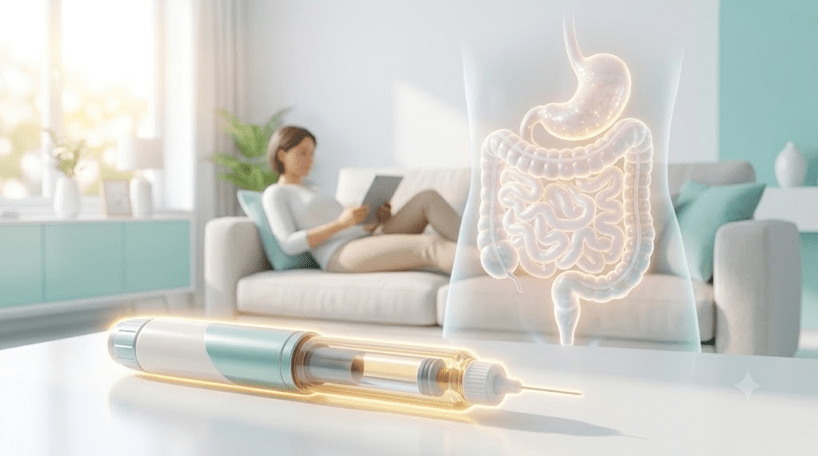
For many years, the most powerful treatments for inflammatory bowel disease (IBD), called biologics, had to be given through a drip in a hospital (intravenous or IV). Recently, a newer version has become available that you can inject yourself at home using a small pen (subcutaneous or SC).
While the medicine is the same, a new study has investigated the “Access Process” – basically, the hurdles and steps you have to go through to actually make the move from the hospital chair to your own sofa.
What the Research Found
This study looked at how smooth (or bumpy) the transition is for patients moving from IV to SC therapy. Researchers wanted to know how long it takes to get the new medicine and what the biggest delays are.
- The Clinical Proof: Previous research already showed that switching to SC medicine is safe and effective. In fact, one major trial found that treatment failure rates actually dropped from 40 per cent to 15 per cent after patients made the switch.
- The Access Hurdles: This new study found that while patients love the convenience, the process of getting insurance approval and pharmacy delivery can sometimes cause “gaps” in treatment.
- Success Rates: Despite the paperwork, the vast majority of patients were able to successfully move to home injections and reported a much higher quality of life because they didn’t have to spend hours in a hospital ward.
How it works
- Intravenous (IV): This is when medicine is put directly into a vein. It usually takes 1 to 2 hours in a clinic.
- Subcutaneous (SC): This means “under the skin.” The medicine is in a pre-filled pen that you click against your thigh or tummy. It takes about 10 seconds.
- Biologics: These are “living” medicines grown in a lab. They act like guided missiles to target the specific proteins causing your inflammation.
- Access Process: This refers to the “behind-the-scenes” work – doctors writing prescriptions, pharmacists checking stock, and insurance companies agreeing to pay for the home-delivery service.
Study Scale and Details
This was a targeted clinical evaluation of the healthcare system’s efficiency. It tracked the journeys of patients moving from hospital-based care to home-based care over several months. While smaller than a global drug trial, it is a vital “real-world” look at how the NHS and other health systems manage your access to advanced treatments.
Why This Matters to You as a Patient
If you are considering moving to home injections, this research is your “roadmap” for what to expect.
- Freedom and Flexibility: The biggest benefit for you is time. This study gives you the scientific proof that moving to SC therapy gives you back your day, removing the need for hospital travel and long infusion appointments.
- Staying in Control: Because you can do the injection yourself, you have more control over your schedule. The research shows that patients who switch often feel more empowered in managing their condition.
- A Safer Journey: Surprisingly, switching might even make your medicine work better. Some data suggests that SC versions keep a more steady level of medicine in your blood compared to the “peaks and valleys” of a drip.
While the “access process” can be slow, knowing the steps helps you and your IBD team plan ahead to ensure there is never a gap in your journey toward health.


Leave a Reply