When you live with Crohn’s disease, long-term inflammation can sometimes cause scar tissue to build up in your intestinal wall. If you’ve previously had bowel surgery to remove an inflamed segment of your intestine, scar tissue can form right where the two ends of your bowel were reconnected. This creates an ileocolonic anastomotic stricture, which is a narrowed passage that makes it hard for food and waste to pass through smoothly, causing pain, bloating, and cramping.
To open these narrowed passages without sending you back to the operating theatre, doctors often perform endoscopic procedures during a camera check. While existing methods like endoscopic balloon dilation (stretching the passage with a tiny inflated balloon) or radial incision and cutting (making precise microscopic cuts in the scar tissue) are helpful, cutting carries a risk of bleeding and the balloon endoscopy might need to be repeatedly carried out, IF it is successful in the first place.
Now, an exploratory clinical study has tested a promising alternative: using temporary self-expandable metallic stents to gently hold the bowel open.
Understanding the Technology: Self-Expandable Metallic Stents
To understand how this procedure works, it helps to break down the medical technology tested in the trial:
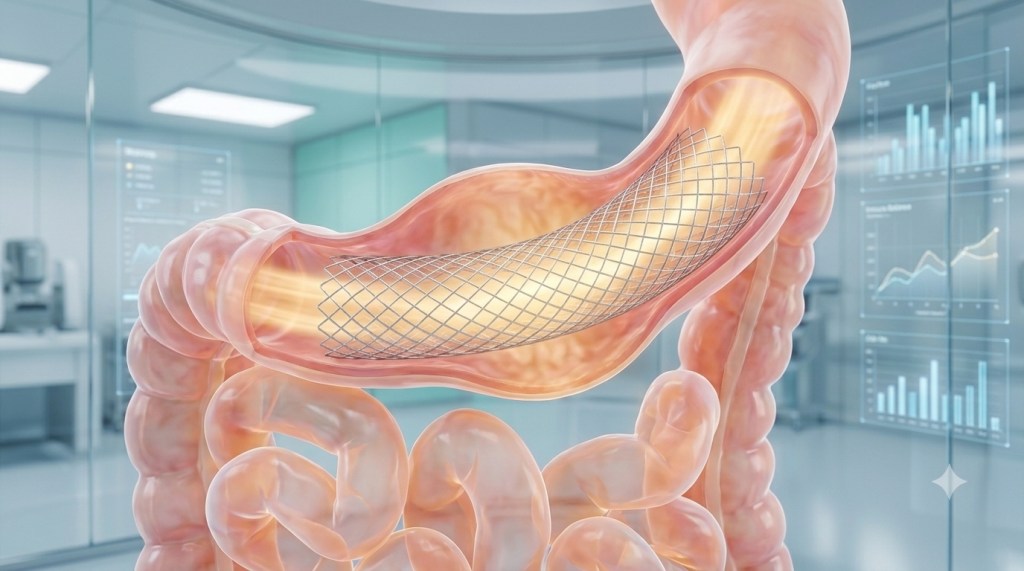
- Self-Expandable Metallic Stents (SEMS): A stent is a tiny, flexible tube made of woven metal mesh. When placed inside a narrowed passage using an endoscope, it gently expands outwards, pushing against the scar tissue to restore a wide, open pathway.
- Temporary One-Week Placement: Unlike permanent stents used in other medical conditions, these metal stents are designed to be left inside the bowel for just one week. This seven-day window allows the scar tissue to adapt and stretch safely before the doctor removes the stent during a quick follow-up procedure.
- Visual Analogue Scale (VAS): To measure how much relief patients felt, researchers used a Visual Analog Scale. This is a simple 1-to-10 rating scale where you can score your pain and discomfort before and after a medical treatment.
Study Scale and How It Was Run
Because this was a brand-new approach for Crohn’s scar tissue, researchers conducted a small, single-centre exploratory pilot study to evaluate safety first.
The trial enrolled 5 adult participants (aged between 18 and 80 years) who had Crohn’s disease, a history of bowel surgery, and recurring strictures at their surgical join that had already been treated with balloon dilation or cutting techniques.
Doctors inserted the metallic stents into the narrowed bowel passages of all five participants. The research team carefully tracked several safety and performance outcomes:
- Safety Checks: Monitoring for adverse events, specifically checking for delayed bleeding or accidental tears in the bowel wall (perforation).
- Technical Success and Stent Removal: Measuring how easily the stents were placed, whether the metal mesh slipped out of position (migration), and how smoothly the stents were removed after one week.
- Symptom Improvement and Hospital Stay: Assessing patient comfort scores and tracking how many days participants spent in hospital.
The exploratory trial confirmed that temporary metallic stent insertion was technically feasible and provided valuable safety data, paving the way for larger clinical trials.
Why This Matters to You as a Patient
If you are managing Crohn’s disease and worried about scar tissue or recurring bowel blockages, this research is a hopeful sign for your future care:
- Proof That Safer Alternatives Are Being Pioneered: This study proves that doctors are actively searching for gentler ways to open narrowed bowel passages. Finding options that reduce the risk of delayed bleeding helps protect you from sudden hospital readmissions.
- Avoiding Repeat Major Surgery: Every time a stricture can be safely opened using an endoscopic procedure, it delays or prevents the need for major bowel resection surgery, helping you preserve as much of your natural intestine as possible.
- Painless Step-by-Step Healing: Knowing that a temporary metal mesh can stretch your bowel safely over seven days gives you confidence that future treatments will focus on long-term comfort and keeping your journey toward health on track.
As researchers refine these non-surgical tools, you and your gastroenterology team will have more flexible, low-risk choices to keep your digestive tract open and clear.


Leave a Reply