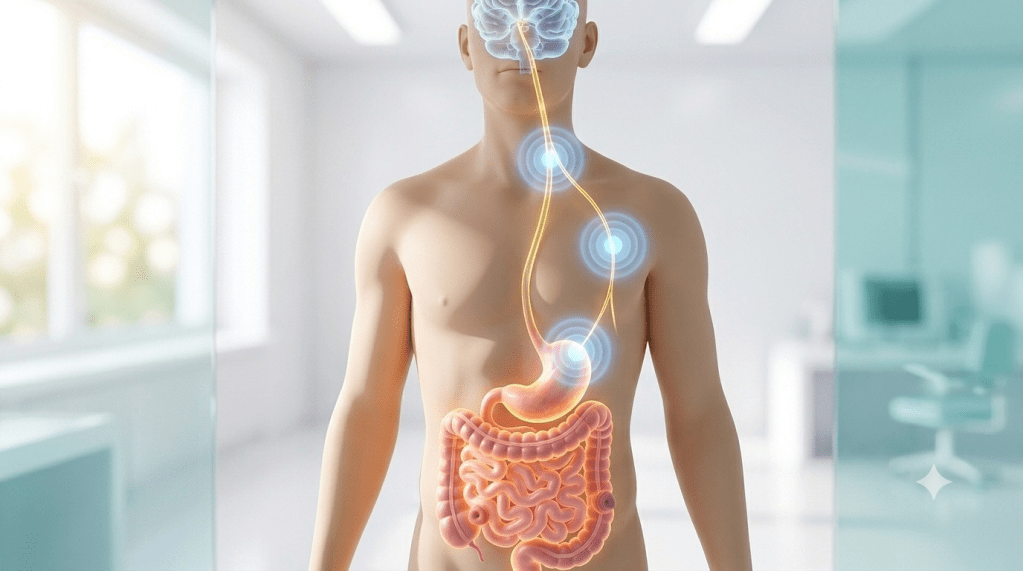
Have you ever felt “butterflies” in your stomach when you are nervous or a “gut feeling” about a decision? It’s not just your imagination. It is your vagus nerve in action. This massive nerve acts like a biological superhighway, carrying constant messages between your brain and your digestive system.
New research is now exploring how we can “hack” this highway to treat chronic conditions like inflammatory bowel disease (IBD) and other gut disorders. In a recent discussion, leading experts explained that understanding this connection could lead to a future where we treat the gut through the nervous system.
What is the Vagus Nerve?
The vagus nerve is the longest nerve in your body. Its name comes from the Latin word for “wandering,” which makes sense because it wanders from your brain stem all the way down to your colon, touching almost every major organ along the way.
It is the main controller of your parasympathetic nervous system. This is the part of your body that tells you to “rest and digest.” When your vagus nerve is working well, it helps keep your gut moving smoothly and, most importantly, it helps keep inflammation under control.
What the Research Discovered
Scientists are looking at a process called Vagus Nerve Stimulation (VNS). This involves using a tiny electrical pulse to “wake up” the nerve and tell it to send calming signals to the gut.
- A Small but Mighty Study: Experts highlighted a small pilot study involving 15 patients with a condition called idiopathic gastroparesis (where the stomach cannot empty itself properly).
- The Duration: The study was a short-term “proof of concept” to see if the technology worked.
- The Results: Using a non-invasive stimulator (a device that does not require surgery), the researchers found that patients saw a significant improvement in their symptoms.
- The Anti-Inflammatory Switch: Most excitingly, new data shows that stimulating the vagus nerve can actually decrease inflammation in the body. The FDA (the medical board that approves new treatments) has already approved an implantable stimulator for people with rheumatoid arthritis, and experts believe the gut is next.
How the technology works
You might hear doctors talk about vagal tone. This is basically a way of measuring how “fit” your vagus nerve is. High vagal tone means your body can relax and recover from stress quickly.
To improve this tone, scientists are developing VNS devices. Some are implantable, which means a tiny wire is placed near the nerve during a small operation. Others are non-invasive, meaning you can hold a device against your neck or ear to send the electrical signal through your skin. It is like using a remote control to turn down the “volume” of inflammation in your gut.
Why This Matters to You as a Patient
If you are living with IBD or a disorder of gut-brain interaction, this research offers you a brand new way to think about your health.
- A Drug-Free Option: While medications like biologics are vital, VNS could provide you with a way to manage inflammation without the side effects that sometimes come with traditional drugs.
- More Than Just a Flare: Many of you experience symptoms like pain or bloating even when your IBD is technically in remission. Because VNS targets the communication between your brain and gut, it could help treat these lingering symptoms that standard medicine might miss.
- Real Science vs. Trends: You may have seen “influencers” on social media talking about ice water plunges to help the vagus nerve. While these can temporarily boost your vagal tone, this new research gives you the scientific proof that medical-grade stimulation can create long-term changes in how your body fights disease.
While large-scale trials for IBD are still in the early stages, the next decade is expected to see a huge increase in these “nerve-hacking” treatments.
Explore the Research
- Original Feature: The Complicated Relationship: Vagus Nerve and the Gut.
- Related Reading: Why your intestinal muscles are a vital command centre.
- Related Reading: Transcutaneous Vagal Nerve Stimulation for Gastrointestinal Disorders


Leave a Reply