When we talk about Inflammatory Bowel Disease (IBD), we usually focus on the “lining” of the gut (the mucosa), which is where doctors see redness and ulcers during a colonoscopy. However, a major new scientific report published on July 9th suggests we need to look deeper.
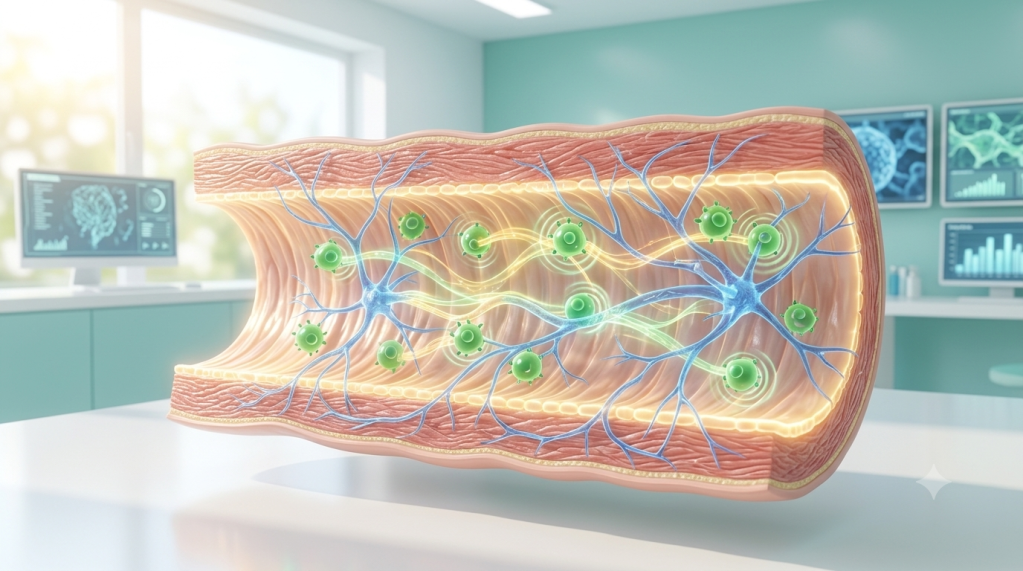
The study highlights a layer called the intestinal muscularis. For a long time, scientists thought this layer was just a simple “muscle” that squeezed food along. We now know it is actually a high-tech “command centre” where your nerves, immune cells, and muscles are constantly talking to each other to keep you healthy.
What the Research Found
This was not a single trial of a few patients, but a comprehensive scientific review that looked at the “big picture” of gut health. It summarised thousands of individual findings to explain how the muscle layer works as an “integrated regulatory hub”.
The researchers discovered that in a healthy gut, this layer coordinates three main things:
- The Movement: It generates the “peristalsis” (waves of movement) needed to digest and push food through.
- The Conversations: It houses the enteric nervous system (the “second brain“), which tells the immune system when to “stand down” and stop causing inflammation.
- The Protective Shield: It contains special resident immune cells (macrophages) that protect your gut nerves from being damaged by infection or flares.
How IBD Changes the ‘Engine Room’
The report explains that in Crohn’s disease and ulcerative colitis (UC), this communication network breaks down:
- In Crohn’s: The muscle layer can become much thicker (hypertrophy), and a “creeping fat” starts to wrap around the outside of the bowel, which can lead to strictures (narrowing).
- In UC: Even though the inflammation starts on the surface, “oxidative stress” can leak down into the muscle layer, causing permanent scarring (fibrosis) and killing off the nerves that control your bowel movements.
Why This Matters to You as a Patient
Understanding that your IBD affects the “engine room” of your gut is important for several reasons:
- Explaining Invisible Symptoms: If you have ever been told your gut looks “healed”, but you still have pain or bathroom urgency, this research provides the answer. The inflammation may have moved into the muscle layer, affecting how your gut moves and senses pain.
- New Treatment Targets: Most current drugs target the immune system. This research suggests that future treatments could focus on repairing the gut’s engine, such as using “friendly” viruses or targeting the brain-gut link to stop the muscle layer from scarring.
- The Diet Connection: The study found that “good bugs” in your microbiome produce molecules called Short-Chain Fatty Acids (SCFAs). These molecules act like “fuel” for your muscle layer, helping it stay strong and fight off inflammation naturally.
By shifting the focus from just “stopping the flare” to “repairing the network,” scientists are opening the door to a new generation of personalised medicine.
Explore the Research
- Original Review: Intestinal muscularis in health and disease.
- Related Reading: How the microbiome and diet drive gut inflammation.
 IBD Science for Patients
Leave a comment