When you live with Crohn’s disease or ulcerative colitis, digestive symptoms like abdominal pain, diarrhoea, and bowel urgency are often front of mind. However, for up to half of all people diagnosed with inflammatory bowel disease (IBD), the illness reaches beyond the digestive tract to cause inflammation in other parts of the body. These secondary symptoms are known as extra-intestinal manifestations (EIMs), and the most common by far is joint pain and swelling, known as IBD-associated arthritis (IAA).
Joint pain in IBD belongs to a broader family of inflammatory joint conditions called spondyloarthritis (SpA), which affects the spine, pelvic joints, and peripheral joints like hips, knees, ankles, and wrists. For years, scientists struggled to explain why an illness originating in the gut would cause painful, stiff joints elsewhere in the body.
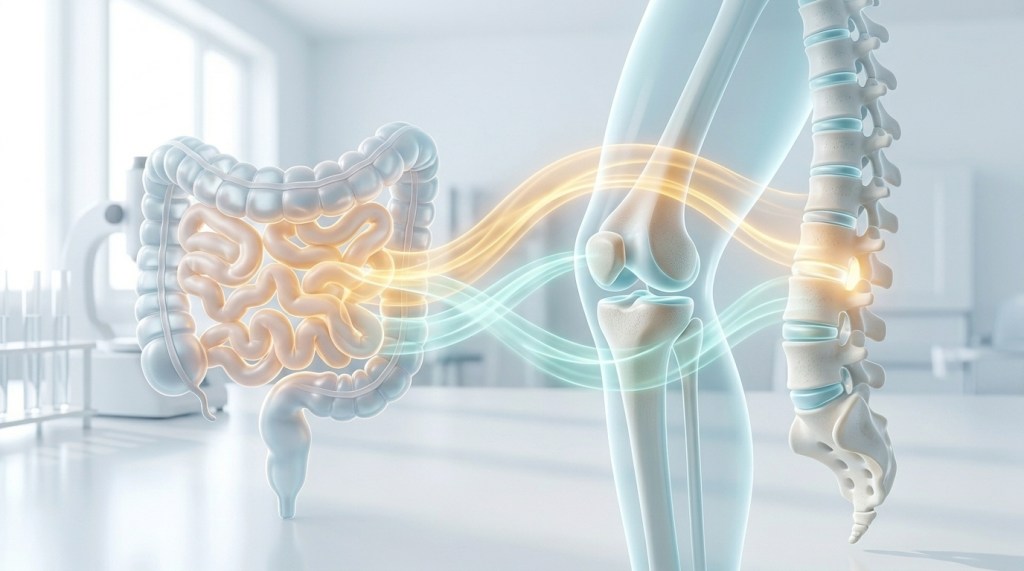
Now, a comprehensive scientific evidence synthesis published in Communications Medicine brings vital clarity. Led by gastroenterology and rheumatology specialists Dr Madeline Alizadeh and Dr Raymond Cross, this major review maps out the gut-joint axis, demonstrating how microscopic disruptions in your intestinal wall, friendly gut bacteria, and microbial chemical signals drive inflammation directly to your joints.
Understanding Your Intestinal Shield and the Gut-Joint Highway
To understand how gut health influences joint comfort, it helps to examine how your intestinal barrier functions when healthy and how modern scientific tools analyse it:
- The Intestinal Barrier and “Leaky Gut”: Your bowel wall is lined by a single layer of specialised cells held tightly together by microscopic protein locks called tight junctions. On top of these cells sits a protective sugary gel coat called the mucous layer (made largely of proteins called mucins, such as MUC2). When inflammation weakens these protein locks, intestinal permeability (IP) increases. This allows bacterial fragments, such as lipopolysaccharide (LPS) from bacterial cell walls, to slip through the gut wall into your bloodstream. Doctors measure this permeability in clinical research using sugar absorption tests, calculating the lactulose-to-mannitol ratio in urine samples.
- Faecal Calprotectin (FCP): A protein released into your stool by white blood cells (neutrophils) when the bowel lining is inflamed. In people with joint pain or spondyloarthritis, elevated faecal calprotectin levels often reveal hidden, silent inflammation along the gut wall, even before digestive symptoms appear.
- Microbial Dysbiosis and High-Tech Sequencing: In a balanced digestive tract, trillions of friendly microbes live in harmony. In IBD and spondyloarthritis, this ecosystem undergoes dysbiosis, where diversity drops, protective bacteria decline, and inflammatory strains multiply. Scientists identify these microbial shifts using 16S rRNA sequencing and metagenomics, high-tech genetic scanning methods that read bacterial DNA barcodes from stool and tissue samples.
- Short-Chain Fatty Acids (SCFAs) and Tryptophan Metabolites: Beneficial chemical compounds produced when friendly gut bacteria digest dietary plant fibres. Key SCFAs, like butyrate, act as the primary fuel source for intestinal wall cells, rapidly repairing tight junction locks and sending calming signals through immune sensors like GPR41 and GPR43. Tryptophan byproducts (indoles) work similarly through aryl hydrocarbon receptors to reinforce gut wall integrity.
Inside the Evidence: Shared Microbial Patterns in Gut and Joint Disease
This publication is a comprehensive scientific narrative and evidence synthesis review. The international research team synthesised data from dozens of clinical cohorts, population studies, and laboratory models evaluating human genetics, stool samples, and intestinal tissue biopsies.
By analysing shared biological markers across thousands of patients with Crohn’s disease, ulcerative colitis, and spondyloarthritis, the review uncovered striking similarities along the gut-joint highway:
- Shared Microbial Loss: Patients with both IBD and inflammatory joint disease show significant drops in key protective, butyrate-producing bacteria, including Faecalibacterium prausnitzii and Roseburia intestinalis.
- Expansion of Inflammatory Microbes: Both conditions are marked by an overgrowth of aggressive bacterial families, such as Enterobacteriaceae (including sticky E. coli strains) and Veillonella, which trigger inflammatory immune signals.
- The Role of Genetic Sensors: Genetic variations in immune receptors, such as NOD2 (which helps your immune system recognise bacterial peptidoglycans) and HLA-B27 (a key genetic marker in spondyloarthritis), alter how your body senses gut bacteria, making the intestinal lining more vulnerable to barrier breakdown.
- Systemic Immune Signalling: When intestinal permeability increases, bacterial fragments and inflammatory messengers (like interleukin-17, interleukin-23, and TNF-alpha) enter circulation, travelling through the bloodstream to trigger swelling and stiffness in joint cartilage and tendon attachments (entheses).
Why This Matters to You as a Patient
If you are managing Crohn’s disease or ulcerative colitis and experience unexplained joint pain, morning stiffness, or skin or eye symptoms, this landmark review offers deep validation and practical hope:
- This Review Proves That Your Joint Pain Is Directly Linked to Your Gut: This review provides evidence that joint stiffness and inflammation are not separate, unrelated problems. They are driven by real, biological signals travelling from your gut lining along the gut-joint axis.
- This Review Shows That Protecting Your Gut Shield Helps Your Whole Body: This review proves that keeping your bowel lining healthy and supported by friendly microbes reduces the leakage of inflammatory bacterial products into your bloodstream, protecting both your gut and your joints.
- This Review Highlights Future Precision Medicine: Scientists are developing cutting-edge organ-on-a-chip technology (3D human tissue models grown on microchips) to test how specific microbial metabolites and targeted therapies interact with human cells. In the future, this will allow doctors to create personalised treatments tailored to your unique microbiome.
By understanding how your gut microbiome influences joint health, you and your care team can take a holistic approach to calming systemic inflammation and protecting your daily mobility.


Leave a Reply